
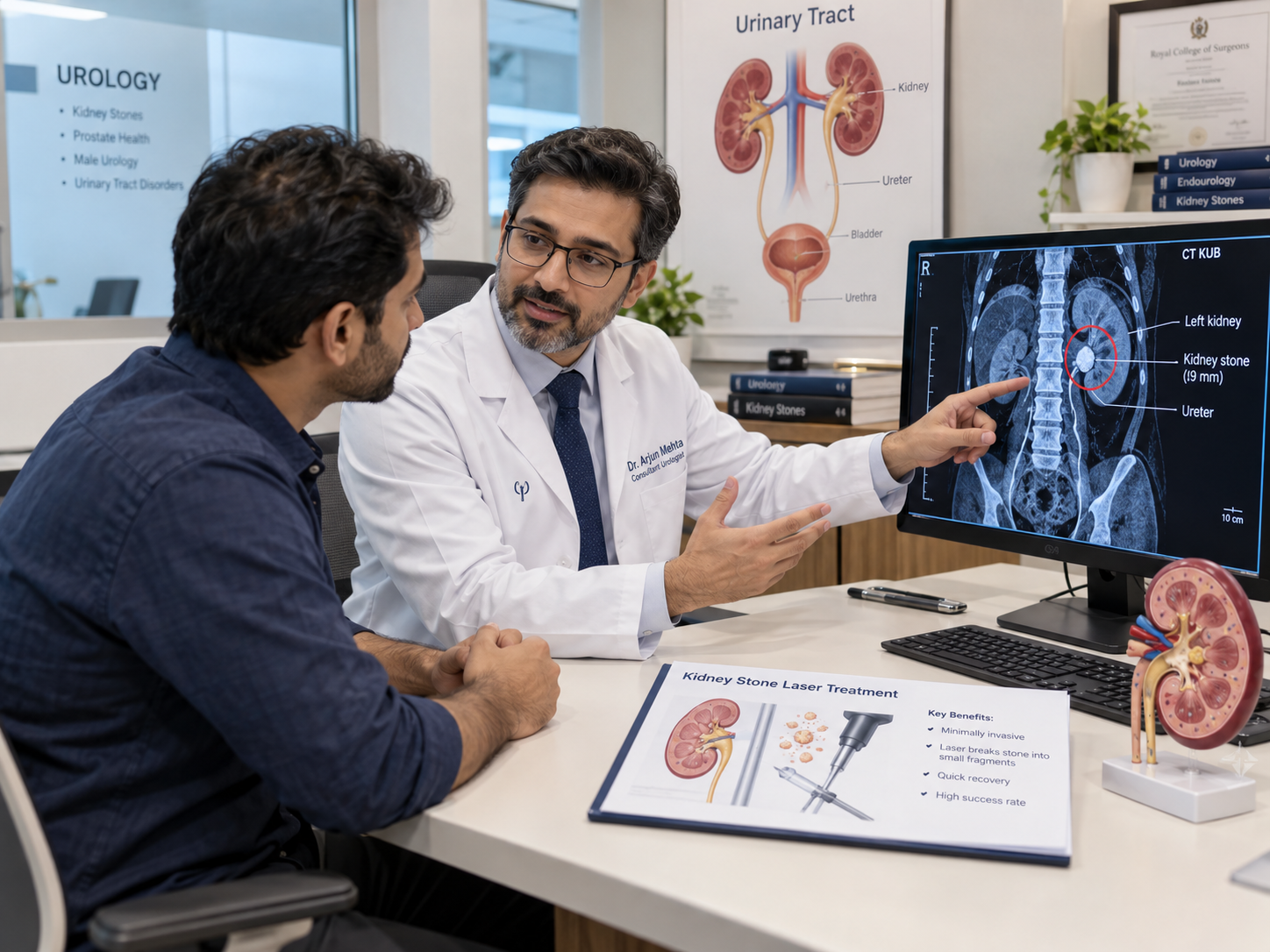
Kidney stones are a common urological problem, and many patients in Bengaluru search for reliable, easy-to-understand information before consulting a doctor. Some stones pass on their own, while others need active intervention because of their size, location, or the symptoms they cause. One widely used option for selected stones is Kidney Stone Laser Treatment in JP Nagar, an endoscopic approach that uses laser energy to break stones into smaller pieces. This article explains what the procedure involves, how it works, its benefits, recovery expectations, and the factors that influence cost, in plain language for patients considering evaluation with a urologist such as Dr. Uday Bhaskar in JP Nagar, Bangalore/Bengaluru.
Kidney stones form when certain substances in urine — such as calcium, oxalate, phosphate, or uric acid — become concentrated enough to crystallise. Over time, these crystals can stick together and form a stone inside the kidney. A stone may remain in the kidney or move into the ureter, the narrow tube connecting the kidney to the bladder, which can cause sudden pain, urinary obstruction, or infection. The most common types include calcium oxalate and calcium phosphate stones, uric acid stones, struvite (infection-related) stones, and cystine stones. Each type forms differently, which is why doctors often try to identify the stone composition when planning treatment or prevention.
What Is Laser Treatment for Kidney Stones?
Laser treatment for kidney stones is an endoscopic technique in which a laser fibre, passed through a thin scope, is used to fragment a stone from inside the urinary tract — not a laser applied externally through the skin. During the procedure, a urologist reaches the stone through the natural urinary passage using a scope, without any surgical cut on the skin. A fine laser fibre is passed through the scope and positioned close to the stone, where laser energy fragments or "dusts" it into smaller pieces. Depending on the stone's size and location, fragments may be removed using a small basket device, or left to pass naturally in the urine over subsequent days. In many cases, a temporary ureteric stent is placed at the end of the procedure to keep the ureter open and support healing while swelling settles. Patients searching for Kidney Stone Laser Treatment in JP Nagar are generally referring to this endoscopic, scope-based laser fragmentation procedure.
How Does Kidney Stone Laser Treatment Work?
The procedure typically follows a structured sequence:
- Evaluation and imaging — Blood tests, urine tests, and imaging such as ultrasound or CT scan help confirm the stone's size, number, and location.
- Anaesthesia — The procedure is usually performed under general or spinal anaesthesia, as advised by the treating team.
- Ureteroscope insertion — A thin scope is passed through the natural urinary passage into the bladder and ureter.
- Locating the stone — The urologist visualises the stone directly using the scope's camera.
- Laser fragmentation — A laser fibre delivered through the scope breaks the stone into smaller fragments or dust.
- Fragment removal — Larger fragments may be retrieved with a basket; smaller dust is often left to pass naturally.
- Stent placement (when required) — A temporary stent may be placed to support urine drainage during healing.
- Recovery and follow-up — Patients are monitored before discharge, with follow-up visits to assess healing and, if applicable, stent removal.
What Is RIRS and How Is It Used for Kidney Stones?
RIRS, or Retrograde Intrarenal Surgery, is a laser-based endoscopic procedure that reaches stones located inside the kidney using a flexible scope passed through the natural urinary passage. Unlike a rigid scope used for ureteric stones, RIRS uses a flexible ureteroscope that can bend and manoeuvre within the kidney's internal drainage system to access stones in different parts of the kidney. A laser fibre passed through this flexible scope is used to fragment or dust the stone, and this is often described as a renal stone laser procedure. Depending on fragment size, pieces may be retrieved with a basket or left to clear naturally. RIRS is generally considered for selected renal stones, but it is not suitable for every case — decisions depend on stone size, location, kidney anatomy, and other clinical factors assessed by the treating urologist. Unlike conventional open surgery, RIRS does not involve a surgical incision, since the kidney is accessed entirely through the natural urinary tract.
What Are the Benefits of Laser Stone Removal?
When appropriate for a particular patient, laser stone removal offers certain potential advantages, while outcomes still vary from person to person:
- It is an endoscopic approach that avoids a large surgical incision.
- It allows the urologist to directly visualise the stone before fragmenting it.
- Laser energy can be adjusted to fragment or dust stones of different hardness.
- Selected kidney and ureteric stones can often be treated in the same sitting.
- Stone fragments may sometimes be retrieved during the same procedure.
- Recovery is generally shorter compared with some traditional open surgical approaches.
These are potential benefits, not guarantees. The procedure is not painless for everyone, does not eliminate all risk of complications, and does not guarantee complete stone clearance in every case. Suitability and outcomes depend on stone size, location, number, composition, urinary anatomy, presence of obstruction or infection, and the patient's overall health.
Who May Need Laser Kidney Stone Treatment?
Not every stone requires a procedure. Small stones may sometimes pass naturally with adequate hydration and monitoring advised by a doctor. Laser treatment may be considered depending on stone size, location, and number; stone composition; degree of urinary obstruction; severity of symptoms; failure of the stone to pass on its own; prior treatment history; individual urinary tract anatomy; presence of infection; kidney function; and the patient's general health status. A thorough clinical evaluation is necessary before deciding on the appropriate approach.
Laser Treatment vs Other Kidney Stone Removal Options
No single treatment is universally superior; the right option depends on individual circumstances.
- Observation/Natural passage — Appropriate for select small stones without significant obstruction or symptoms, monitored periodically.
- Medical expulsive therapy — Certain medicines may help facilitate passage of some ureteric stones, depending on stone size and location.
- Shock Wave Lithotripsy (SWL/ESWL) — Uses focused shock waves from outside the body to fragment stones, which then pass in the urine.
- Ureteroscopy with laser — A scope is passed into the ureter (and sometimes the kidney) to fragment the stone directly with laser energy.
- RIRS — A flexible scope-based, laser fragmentation technique for stones located within the kidney.
- PCNL (Percutaneous Nephrolithotomy) — Involves a small tract created through the skin into the kidney, generally considered for larger or more complex renal stones. Mini-PCNL uses smaller instruments for selected cases.
The treating urologist reviews imaging, stone characteristics, and patient factors to recommend the most appropriate option.
When Is Kidney Stone Removal Necessary?
Active treatment, including kidney stone removal JP Nagar patients often seek locally, may be recommended when symptoms are persistent or severe, when a stone is unlikely to pass naturally due to its size or position, when there is urinary obstruction, when infections keep recurring because of the stone, when kidney function is affected or obstruction risk is a concern, when a stone is increasing in size on follow-up imaging, or when other complications arise. These decisions always require individualised medical evaluation rather than a fixed rule.
What Is Recovery Like After Laser Kidney Stone Treatment?
Recovery varies based on the specific procedure performed, stone burden, whether a stent was placed, and individual health. Immediately after the procedure, patients may notice mild urinary discomfort, occasional blood-tinged urine, or urgency and frequency, particularly if a stent is in place. The treating doctor usually advises adequate hydration and may prescribe medication for comfort or to prevent infection. Follow-up visits are important to assess healing, review any residual fragments, and remove the stent when applicable. Return to normal activities depends on the type of procedure performed and how each patient recovers; there is no single fixed timeline that applies to everyone considering kidney stone laser surgery JP Nagar clinics may offer.
What Are the Risks of Laser Stone Treatment?
Although commonly performed, laser stone procedures are not risk-free. Possible issues include temporary blood in the urine, burning or discomfort during urination, urinary frequency, stent-related symptoms, infection, injury to the ureter, residual stone fragments that may need further treatment, and anaesthesia-related risks. Serious complications are uncommon but possible, and no procedure can be described as zero-risk. Follow-up care helps identify and manage any issues early.
How Much Does Laser Kidney Stone Treatment Cost?
The cost of laser kidney stone treatment in Bangalore varies considerably and cannot be quoted as a fixed figure without patient-specific evaluation. Cost is influenced by stone size, number, and location; whether the stone is in the kidney or ureter; the specific procedure required (ureteroscopy, RIRS, PCNL, or Mini-PCNL); need for stent placement; type of anaesthesia; imaging and laboratory investigations; hospital or facility charges; surgeon and specialist fees; medical consumables such as laser fibres and scopes; follow-up visits and stent removal; whether additional procedures are needed; and insurance coverage or policy terms. Patients are encouraged to request a personalised cost estimate only after clinical evaluation and imaging.
How Can Kidney Stones Be Prevented After Treatment?
Prevention strategies are ideally based on stone type and individual risk factors rather than a generic diet. Doctors commonly advise adequate fluid intake as recommended for the individual, dietary adjustments suited to the stone type identified, reducing excessive salt intake, moderating intake of specific stone-forming foods when medically appropriate, and maintaining a reasonable dietary calcium intake rather than eliminating it unnecessarily. Stone analysis, when available, and metabolic evaluation for patients with recurrent stones can help guide more targeted prevention. Periodic follow-up imaging and regular follow-up with a urologist support long-term monitoring.
When Should You See a Urologist?
Patients should seek prompt medical attention for severe or worsening pain, fever or chills, difficulty passing urine, significant blood in the urine, persistent vomiting, symptoms suggestive of infection, or any sudden deterioration in condition. Fever combined with an obstructed urinary system can indicate a urgent situation that needs prompt medical assessment.
Kidney Stone Laser Treatment in JP Nagar
Patients in JP Nagar and surrounding parts of Bengaluru who are dealing with kidney or ureteric stones may seek a urological evaluation to understand whether Renal stone laser treatment in JP Nagar, RIRS, ureteroscopy, ESWL, PCNL, or simple observation is the more appropriate path for their specific stone. Laser-based fragmentation is one of several established options, but it is not suitable for every patient or every stone. A clinical assessment involving imaging, stone characteristics, and overall health is necessary before any treatment decision is made.
Why Consult an Experienced Urologist for Kidney Stone Treatment?
A urologist plays a central role in confirming the diagnosis, reviewing imaging studies, assessing stone size and location, selecting an appropriate treatment approach, performing the chosen procedure, managing any stent placed during treatment, monitoring recovery, and guiding strategies to reduce the risk of recurrence. Dr. Uday Bhaskar, practising as a urologist and andrologist in JP Nagar, evaluates patients individually to determine whether laser treatment, RIRS, ureteroscopy, or another option is appropriate for their specific stone.
Conclusion
Kidney stones vary widely in cause, size, and composition, and not every stone needs the same approach. Some pass naturally with monitoring, while others require active treatment such as laser fragmentation through ureteroscopy or RIRS. These endoscopic techniques are established options for selected kidney and ureteric stones, but treatment selection always depends on individual clinical factors, and recovery and cost differ from patient to patient. Ongoing follow-up and attention to prevention remain important after any stone procedure.
Medical Disclaimer: The information provided is for general educational purposes and is not a substitute for professional medical evaluation, diagnosis or treatment. Kidney stone treatment depends on factors such as stone size, location, obstruction, infection status and the patient's overall health. Patients with symptoms should consult a qualified healthcare professional or urologist.