
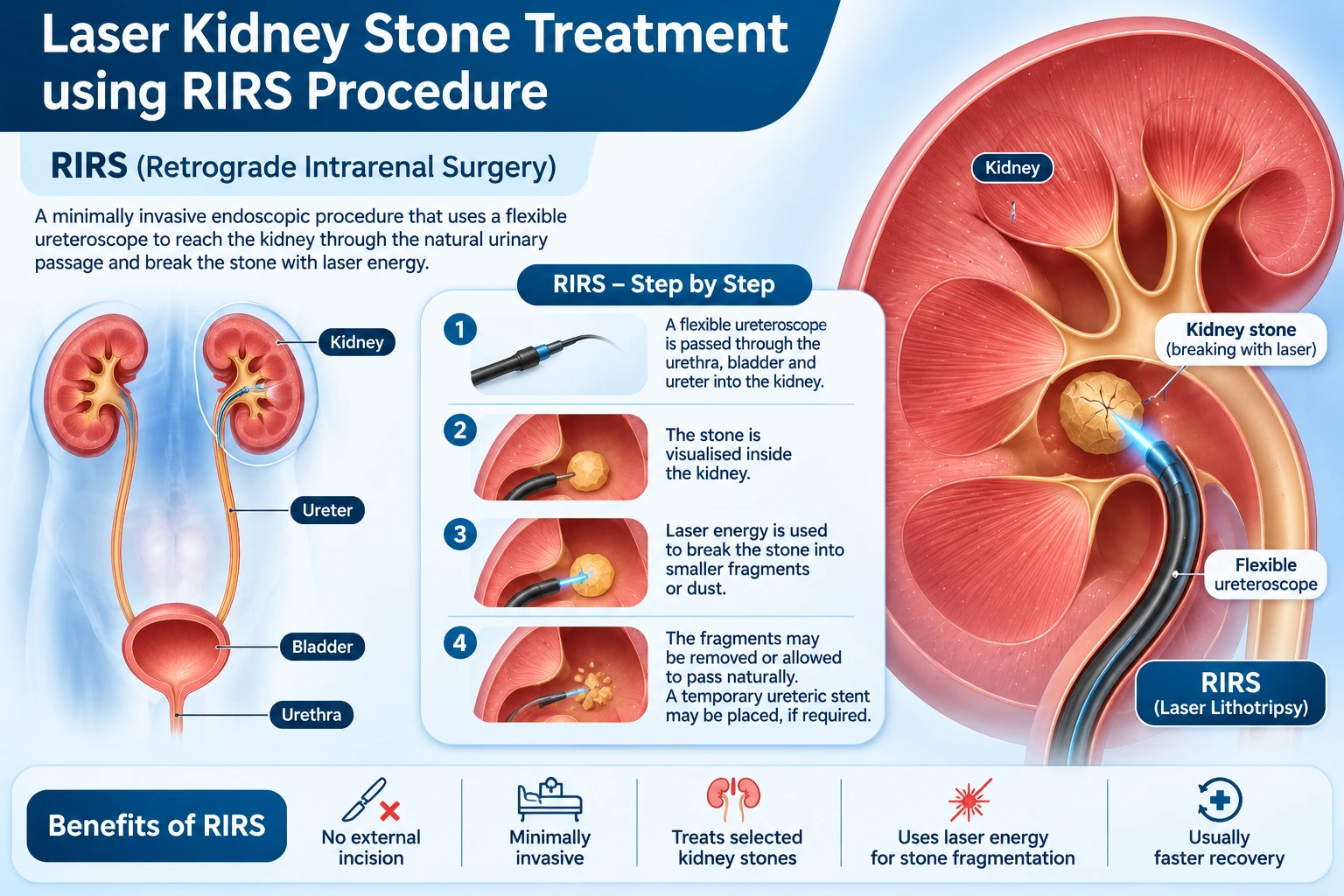
Kidney stones can cause severe pain, urinary problems and complications when they block the normal flow of urine. Depending on their size and location, some stones pass naturally, while others require a medical or surgical procedure. Laser technology is used in selected endoscopic procedures to break kidney and ureteric stones into smaller fragments.
People searching for Laser Kidney Stone Treatment in Hennur often want to understand how laser procedures work, whether RIRS is suitable for their condition and what recovery involves.
Dr. Uday Bhaskar, a Urologist and Andrologist in Bangalore, provides evaluation and management for various urinary stone conditions. Patients from Hennur can enquire about consultation arrangements and suitable treatment options.
What Is Laser Kidney Stone Treatment?
Laser kidney stone treatment involves using laser energy through an endoscopic instrument to fragment stones inside the urinary tract.
A commonly used approach is Retrograde Intrarenal Surgery, also known as RIRS. During this procedure, a flexible ureteroscope is passed through the urethra and bladder into the ureter and kidney.
A laser fibre is introduced through the endoscope to break the stone into smaller fragments or dust-like particles, depending on the surgical technique.
People considering Laser Kidney Stone Treatment in Hennur should understand that laser treatment is not one single procedure. The approach depends on the location, size, number and density of stones.
What Is RIRS?
RIRS stands for Retrograde Intrarenal Surgery. It is a minimally invasive endoscopic procedure used to treat selected kidney stones.
Unlike procedures that require an incision through the skin, RIRS accesses the kidney through the natural urinary passage.
The main steps generally include:
- Anaesthesia is administered according to the surgical plan.
- A ureteroscope is introduced through the urethra and bladder.
- The instrument is guided through the ureter into the kidney.
- A laser fibre is passed through the scope.
- The stone is fragmented using laser energy.
- Fragments may be removed or allowed to pass, depending on the procedure.
- A temporary ureteric stent may be placed when clinically required.
Read more about RIRS – Retrograde Intrarenal Surgery.
Who May Need Laser Kidney Stone Treatment?
A urologist may consider laser treatment for patients with selected kidney or ureteric stones.
It may be considered when:
- The stone is unlikely to pass naturally.
- The stone causes recurring pain.
- There is an obstruction in the urinary tract.
- Medical management has not been successful.
- The stone's location is suitable for endoscopic treatment.
- The doctor considers RIRS appropriate after reviewing imaging and other investigations.
Not every patient is suitable for RIRS. Larger or complex stones may require another procedure, such as PCNL.
Symptoms That May Indicate Kidney Stones
Before recommending Laser Kidney Stone Treatment in Hennur, the doctor evaluates the symptoms and confirms the diagnosis.
Common symptoms include:
Pain in the Flank
Pain may develop on one side of the back or below the ribs. It may spread towards the lower abdomen or groin.
Blood in Urine
Stones may irritate the urinary tract and cause visible or microscopic blood in the urine.
Burning Urination
A burning sensation may occur due to urinary tract irritation or an associated infection.
Nausea and Vomiting
Severe stone-related pain may be accompanied by nausea or vomiting.
Frequent Urination
A stone close to the bladder may cause urinary urgency and increased frequency.
Fever and chills with suspected urinary obstruction require urgent medical attention.
How Is the Patient Evaluated Before Laser Surgery?
A proper evaluation helps the urologist choose the correct treatment method.
Investigations may include:
Ultrasound: Helps identify stones and signs of urinary obstruction.
CT Scan: Provides detailed information about stone size, number, location and density.
Urine Examination: Helps identify blood and possible urinary infection.
Urine Culture: May be required to identify bacteria and guide infection management.
Blood Tests: May assess kidney function and other relevant parameters.
Before an elective stone procedure, any active urinary infection must be assessed and appropriately treated.
Laser Kidney Stone Treatment Options
Different endoscopic and surgical procedures are available depending on the stone characteristics.
1. RIRS with Laser Lithotripsy
RIRS uses a flexible ureteroscope to reach kidney stones through the urinary tract. Laser energy is used to fragment the stone.
It may be considered for selected renal stones based on their size, position and clinical suitability.
2. Ureteroscopy with Laser Lithotripsy
This procedure is commonly used for selected ureteric stones. The ureteroscope is passed through the urinary passage to reach the stone, which is then fragmented with laser energy.
3. PCNL
Percutaneous Nephrolithotomy is used for selected larger or complex kidney stones. The surgeon reaches the kidney through a small tract created through the back.
The procedure may be preferred when the stone burden is unsuitable for RIRS alone.
Patients looking for Kidney Stone Surgery in Hennur should ask the urologist why a particular technique is recommended for their stone characteristics.
What Are the Possible Benefits of RIRS?
For appropriately selected patients, RIRS offers several procedural advantages:
- Access to kidney stones through the natural urinary passage
- No external incision through the back
- Ability to treat selected stones in different kidney locations
- Use of laser energy for stone fragmentation
- Possibility of treating selected stones in a minimally invasive manner
However, the procedure has limitations. Multiple sessions may be needed for some stones, and complete stone clearance is not guaranteed in every case.
What Happens After Laser Kidney Stone Surgery?
Recovery varies according to the procedure performed, stone burden, patient health and whether a ureteric stent has been placed.
Some patients may experience temporary:
- Mild blood in urine
- Burning sensation during urination
- Frequent urination
- Bladder discomfort
- Flank discomfort, especially with a ureteric stent
The doctor provides instructions about medication, activity, hydration and follow-up.
Severe pain, fever, chills, inability to pass urine or heavy bleeding should be reported promptly.
What Is a Ureteric Stent?
A ureteric stent is a thin flexible tube placed between the kidney and urinary bladder.
It may be used after stone surgery to help urine drain from the kidney into the bladder and support healing.
Some patients experience urinary urgency, frequent urination or discomfort while the stent is present.
The stent must be removed or exchanged according to the doctor's instructions. Patients should not miss their scheduled stent-removal appointment.
How Much Time Does Recovery Take?
Recovery depends on the surgical procedure and the patient's overall condition.
Many patients resume routine activities gradually after the doctor confirms that recovery is progressing appropriately.
The treating urologist will advise when to return to work, exercise and other activities.
People searching for Laser Kidney Stone Treatment in Hennur should discuss expected recovery and follow-up requirements before undergoing surgery.
How Can Kidney Stone Recurrence Be Reduced?
Treatment removes or fragments existing stones, but it does not automatically eliminate the factors responsible for stone formation.
Preventive measures may include:
- Maintaining adequate fluid intake
- Reducing excess dietary salt
- Following a balanced diet
- Maintaining a healthy body weight
- Completing stone analysis when available
- Undergoing metabolic evaluation for recurrent stones
- Following prescribed preventive medication
Dietary advice should depend on the type of stone. Avoid making major dietary changes without medical guidance.
Consult Dr. Uday Bhaskar for Kidney Stone Evaluation
Dr. Uday Bhaskar is a Urologist and Andrologist with over 20 years of experience in urological care and surgical procedures.
His clinical practice includes kidney stone management, RIRS, PCNL, prostate conditions and other urological procedures.
Patients searching for Laser Kidney Stone Treatment in Hennur can enquire about consultation availability and discuss whether RIRS or another treatment option is appropriate.
The final treatment recommendation depends on diagnostic findings and individual medical requirements.
Conclusion
Laser procedures such as RIRS are used to treat selected kidney stones through minimally invasive endoscopic techniques. The choice of procedure depends on stone size, location, density and the patient's overall health.
If you are researching Laser Kidney Stone Treatment in Hennur, Kidney Stone Surgery in Hennur or other kidney stone procedures, consult Dr. Uday Bhaskar for an evaluation and discussion of available treatment options.