
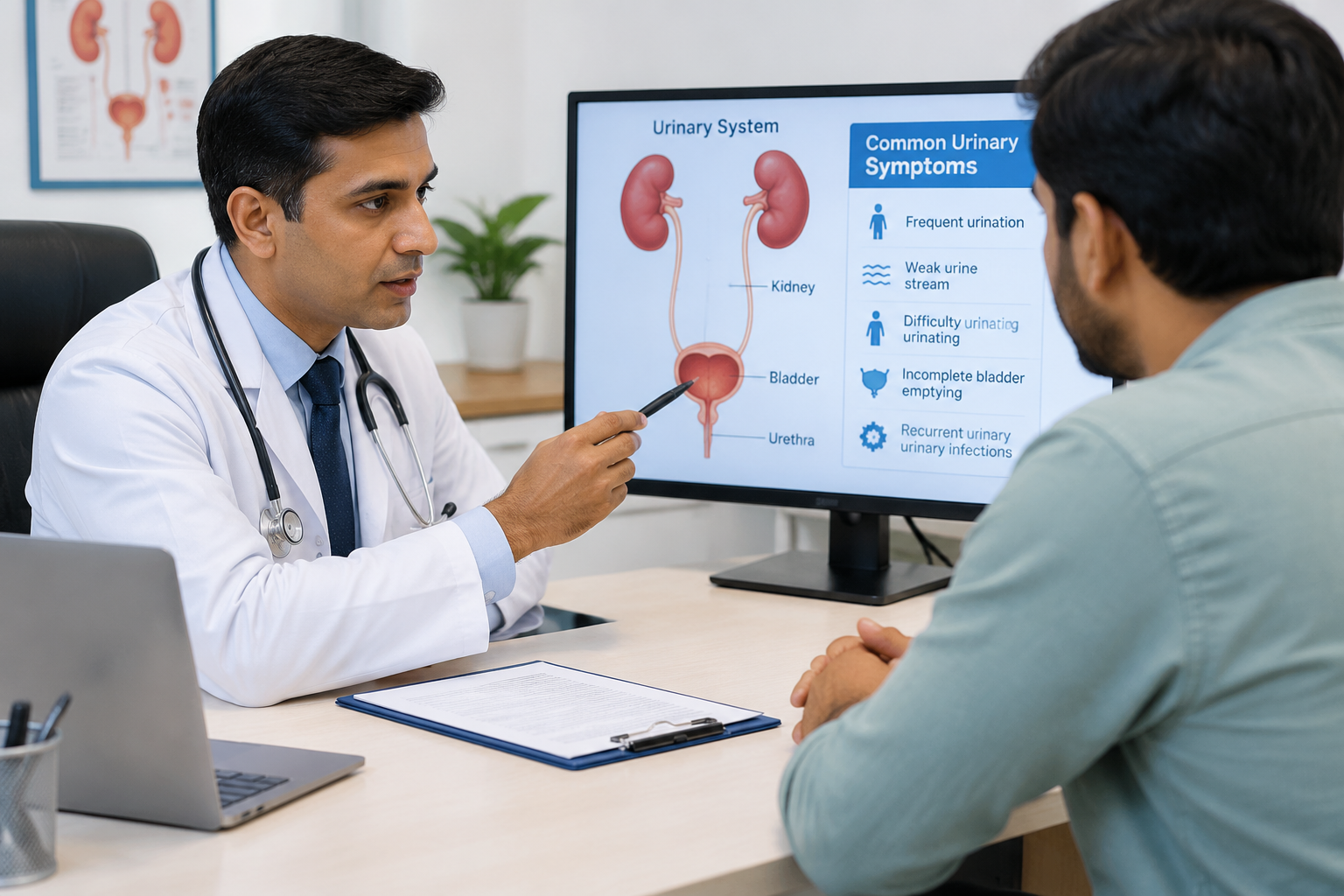
A weak or interrupted urinary stream is often brushed aside as a minor inconvenience, but it can sometimes point to a narrowing within the urethra known as a urethral stricture. This condition can gradually worsen if left unaddressed, making early evaluation important. Persistent changes in urination are worth discussing with a qualified urologist rather than managing on assumption alone.
Dr. Uday Bhaskar , Urologist & Andrologist, sees patients in Jayanagar, Bangalore/Bengaluru, with questions about urinary symptoms and urethral narrowing. This article provides general educational information; it does not state that any specific procedure described here is performed by Dr. Uday Bhaskar, and patients should confirm this directly during consultation.
What Is a Urethral Stricture?
A urethral stricture is a narrowing of the urethra, the tube that carries urine out of the bladder, caused by the formation of scar tissue. This scarring reduces the diameter of the urethral passage, restricting how easily urine can flow through it.
Because many conditions can cause similar urinary symptoms — including prostate enlargement, bladder outlet problems, and urinary stones — a urethral stricture cannot be diagnosed on symptoms alone. Specific tests are needed to confirm whether narrowing of the urethra itself is responsible for a patient's symptoms, or whether another cause is involved.
What Are the Symptoms of Urethral Stricture?
Common symptoms include a weak or slow urinary stream, straining to begin or maintain urination, and a stream that sprays or splits rather than flowing in a single line. Many patients also describe a sensation that the bladder has not emptied completely, along with increased urinary frequency and urgency.
Other possible symptoms include pain or discomfort while urinating, recurrent urinary tract infections, and, in more advanced cases, urinary retention — a sudden or complete inability to pass urine. Difficulty urinating that persists or worsens over time should not be ignored, as early evaluation generally allows for a wider range of management options.
What Causes Urethral Stricture?
Previous Catheterisation or Medical Procedures
Insertion of a urinary catheter or other instruments into the urethra can occasionally cause minor injury that heals with scar tissue, which may narrow the passage over time.
Trauma and Injury
Pelvic fractures or direct injury to the perineal area (the region between the scrotum and anus) can damage the urethra and lead to stricture formation, sometimes appearing months or years after the original injury.
Infections and Inflammation
Certain urethral infections and inflammatory processes can contribute to scarring within the urethral lining over time.
Previous Urethral Surgery
Patients who have undergone earlier urethral or prostate procedures may be at increased risk of developing a new or recurrent stricture at the treated site.
Lichen Sclerosus and Other Conditions
Lichen sclerosus, a chronic inflammatory skin condition that can affect the genital area, is recognised as a cause of urethral stricture in some men, particularly affecting the outer portion of the urethra.
Idiopathic Urethral Stricture
In a proportion of cases, no clear underlying cause can be identified despite thorough evaluation. These are referred to as idiopathic strictures.
What Is Urinary Blockage in Men?
Urinary blockage in men refers to any obstruction that interferes with the normal flow of urine from the bladder out of the body. Urethral stricture is one possible cause, but urinary obstruction can also result from an enlarged prostate, bladder outlet obstruction, urinary stones lodged in the urethra, or other urological conditions.
Because these conditions can produce overlapping symptoms — weak stream, straining, incomplete emptying — the specific cause of urinary blockage cannot be determined from symptoms alone. Proper clinical evaluation is necessary to identify the underlying reason and guide appropriate treatment.
How Is Urethral Stricture Diagnosed?
Medical History and Physical Examination
The evaluation typically begins with a detailed history covering previous catheterisation, urethral trauma, infections, prior surgery, and the nature and duration of current urinary symptoms, along with a physical examination.
Urine Tests
Urine testing can help identify infection or other abnormalities that may be contributing to or resulting from urinary obstruction.
Uroflowmetry
Uroflowmetry is a non-invasive test that measures the speed and pattern of urine flow, helping to identify whether obstruction is present and providing an objective baseline for monitoring.
Post-Void Residual Measurement
This measures the amount of urine remaining in the bladder after urination, usually using ultrasound, and helps assess how effectively the bladder is emptying.
Retrograde Urethrogram
A retrograde urethrogram uses contrast dye and X-ray imaging to outline the urethra, helping identify the precise location, length and severity of a stricture — information that is important for planning treatment.
Cystoscopy
Cystoscopy involves passing a thin, flexible camera through the urethra to directly visualise the urethral lining and bladder, allowing the urologist to assess the stricture and rule out other conditions.
What Are the Treatment Options for Urethral Stricture?
Treatment depends on the stricture's location, length, degree of narrowing, underlying cause, symptom severity, and whether it is a first occurrence or a recurrence. There is no single treatment suitable for every patient.
Observation and Monitoring
In selected cases with mild or stable symptoms, careful monitoring rather than immediate intervention may be a reasonable approach, depending on clinical judgment.
Urethral Dilation
Urethral dilation involves gradually stretching the narrowed segment using specialised instruments. It may temporarily widen the urethra and improve urine flow, but strictures treated this way can recur, sometimes requiring repeated dilation over time.
Direct Vision Internal Urethrotomy (DVIU)
DVIU is an endoscopic procedure in which a surgeon uses a specialised instrument, guided by direct vision through a scope, to incise the scarred segment and widen the urethral passage. It may be appropriate for selected shorter strictures, though recurrence is possible, and the likelihood of a favourable outcome depends on stricture characteristics such as length and location.
Urethroplasty
Urethroplasty is a reconstructive surgical procedure in which the narrowed or scarred segment of the urethra is repaired or reconstructed, sometimes using tissue grafts. Urethral stricture surgery of this type is generally considered for longer, more complex, or recurrent strictures where dilation or DVIU are unlikely to provide durable results. Different urethroplasty techniques exist, and the choice depends on the stricture's location and characteristics, determined after detailed evaluation.
When Is Urethral Stricture Surgery Necessary?
Surgical treatment may be considered when urinary symptoms significantly affect quality of life, when there is substantial narrowing on imaging or cystoscopy, when less invasive options such as dilation or DVIU are unlikely to be effective, or when a stricture has recurred after previous treatment. Surgery is not automatically required for every patient — treatment decisions should be individualised based on a thorough clinical assessment by a urologist.
Can Urethral Stricture Come Back After Treatment?
Because urethral stricture results from scar tissue formation, there is a possibility of recurrence after treatment, regardless of the method used. This is why follow-up matters: monitoring urinary flow, watching for recurring symptoms such as weakening stream or straining, and promptly reporting any changes to the treating urologist all help catch recurrence early. Previous treatment history is an important factor when planning any further intervention, as it can influence which options remain suitable.
Urethral Stricture Treatment in Jayanagar
Patients in Jayanagar, Bangalore/Bengaluru, experiencing persistent urinary symptoms are encouraged to seek evaluation from a qualified urologist familiar with the diagnosis and management of urethral narrowing. Establishing an accurate diagnosis — through history, examination and appropriate imaging or endoscopic assessment — is a necessary first step before urethral stricture treatment in Jayanagar or any specific procedure can be planned. This section does not claim specific facilities, hospital affiliations or availability of any procedure and is intended for general educational awareness.
Urethral Stricture Doctor in Jayanagar
When choosing a urethral stricture doctor in Jayanagar, patients may find it helpful to consider the doctor's relevant urology qualifications, experience evaluating urinary obstruction, access to appropriate diagnostic facilities such as uroflowmetry and imaging, willingness to discuss multiple treatment options rather than a single approach, clarity in explaining risks and benefits, and a clear plan for follow-up care. These considerations are more meaningful than unverified claims of being the "best," and treatment outcomes cannot be guaranteed for any individual patient.
Urethral Stricture Treatment Cost in Bangalore
Urethral stricture treatment cost in Bangalore varies considerably and depends on several factors: the type of treatment recommended (dilation, DVIU, or urethroplasty), the diagnostic tests required, the complexity and length of the stricture, procedure duration, the type of anaesthesia used, the hospital or surgical facility chosen, and whether the approach is endoscopic or reconstructive. Post-operative care and follow-up requirements can also affect overall cost.
Because these factors differ from patient to patient, it is not possible to provide a fixed or general price here. Patients are advised to obtain a personalised cost estimate only after clinical evaluation and diagnosis by a treating urologist.
When Should You See a Urologist?
Prompt evaluation is advisable if you experience a persistently weak urinary stream, ongoing difficulty urinating, recurrent urinary tract infections, pain during urination, or a sensation of incomplete bladder emptying. A history of urethral injury, previous catheterisation, or prior urethral surgery are also reasons to seek assessment even without current symptoms, since strictures can develop gradually. A sudden inability to pass urine is a medical emergency requiring immediate attention.
Men in Jayanagar with these concerns may wish to consult a urethral stricture specialist in Jayanagar for proper diagnostic evaluation and discussion of appropriate next steps.
How Can Urethral Stricture Be Managed After Treatment?
Ongoing management after treatment typically includes scheduled follow-up appointments, monitoring of urinary symptoms, periodic uroflowmetry where recommended, and careful adherence to catheter care instructions if a catheter was used after the procedure. Promptly reporting any recurrence of weak stream, straining or infection allows earlier intervention. Where possible, avoiding unnecessary further urethral instrumentation may also help reduce the risk of additional scarring.
Why Choose an Experienced Urologist for Urethral Stricture Care?
Effective management of urethral stricture depends on accurate diagnosis, a clear understanding of urethral anatomy, identification of the likely cause, and careful assessment of stricture length and location using appropriate imaging and endoscopy. An experienced urologist should also account for any previous treatments, clearly explain the available options along with their respective benefits and risks, and provide structured long-term follow-up. This article does not make specific claims about Dr. Uday Bhaskar's individual surgical experience with urethral stricture procedures; patients should confirm relevant details directly during consultation.
Conclusion
A urethral stricture is a narrowing of the urethra caused by scar tissue, which can lead to a weak urinary stream, difficulty urinating, and other urinary symptoms. Diagnosis typically involves a combination of urine tests, uroflowmetry, imaging such as a retrograde urethrogram, and cystoscopy. Treatment depends on the stricture's location, length, severity and recurrence history, and may range from dilation and DVIU to reconstructive urethroplasty in selected cases. No single treatment is right for every patient, and persistent urinary symptoms are best evaluated by a qualified urologist.
Medical Disclaimer
The information provided in this article is for general educational purposes only and should not be considered a substitute for personalised medical advice, diagnosis or treatment. Urethral symptoms can have several causes, and appropriate testing and treatment should be determined by a qualified healthcare professional based on individual circumstances.