
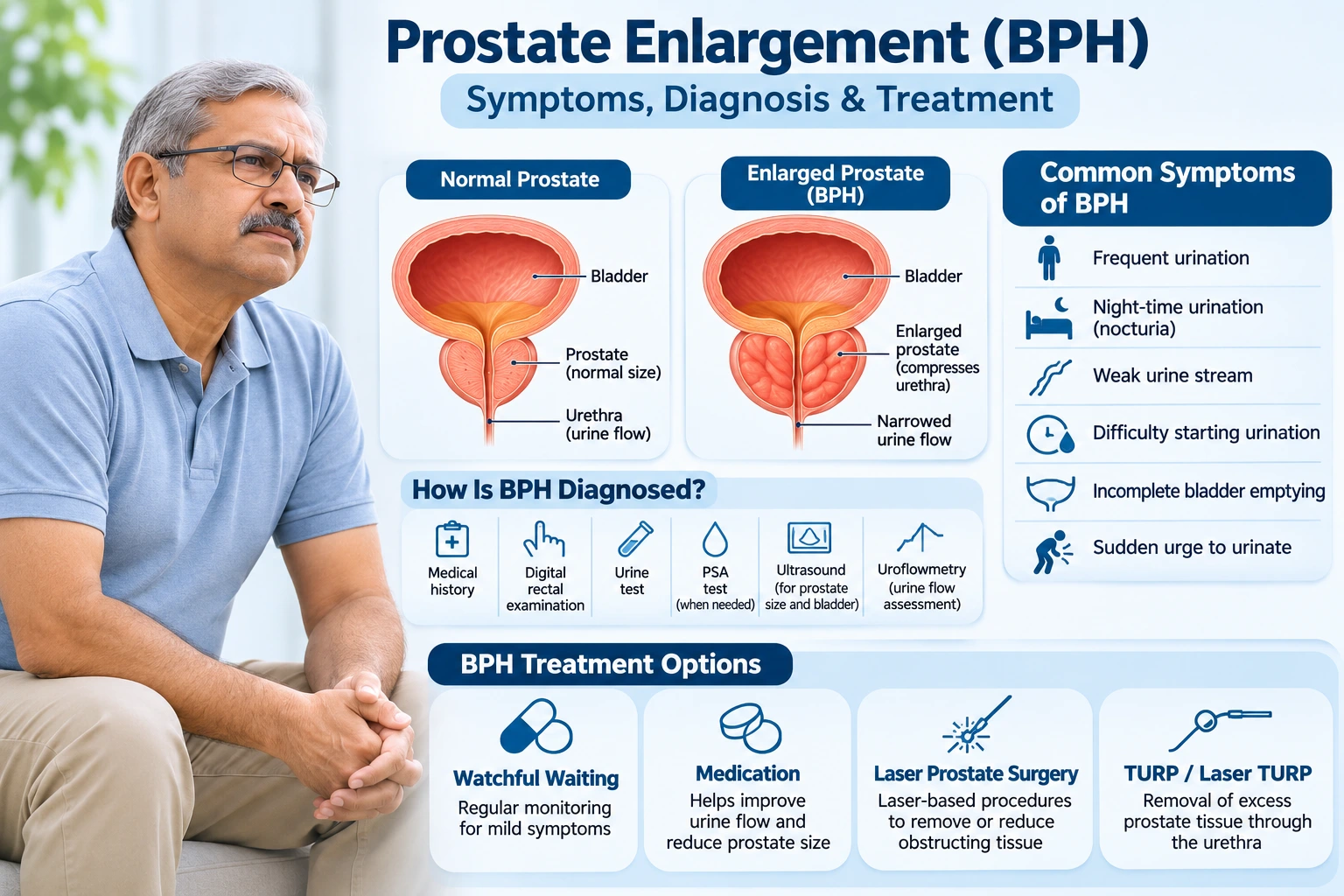
Prostate-related urinary problems are common among ageing men. Conditions such as benign prostatic hyperplasia (BPH), prostate inflammation and prostate cancer can affect urinary function and overall health. Early evaluation helps identify the underlying condition and determine the appropriate treatment approach.
Men searching for Prostate Treatment in Hennur may be experiencing frequent urination, weak urine flow, difficulty starting urination or repeated night-time bathroom visits.
A qualified urologist can evaluate these symptoms and recommend suitable investigations.
Dr. Uday Bhaskar, a Urologist and Andrologist in Bangalore with over 20 years of experience, manages various prostate and urinary conditions. Patients from Hennur can enquire about consultation availability and treatment options.
What Is the Prostate Gland?
The prostate is a small gland located below the urinary bladder and surrounding the upper part of the urethra.
It forms part of the male reproductive system and contributes fluid to semen.
The prostate may increase in size with age. When enlargement compresses the urethra, it can interfere with the normal flow of urine.
However, not every prostate condition is caused by enlargement. Prostatitis and prostate cancer are separate medical conditions that require appropriate assessment.
What Is Benign Prostatic Hyperplasia (BPH)?
Benign Prostatic Hyperplasia, commonly called BPH, is a non-cancerous enlargement of the prostate gland.
As the prostate grows, it may compress the urethra and partially obstruct urine flow.
BPH becomes more common with increasing age. The severity of symptoms does not always correspond directly to the size of the prostate.
Men looking for Prostate Treatment in Hennur should undergo medical evaluation rather than assuming that all urinary symptoms are caused by BPH.
Common Symptoms of Prostate Enlargement
Prostate enlargement can cause lower urinary tract symptoms.
1. Frequent Urination
A person may need to pass urine more often than usual, including during the daytime.
2. Nocturia
Nocturia refers to waking up at night to urinate. It can disturb sleep and affect daily activities.
3. Weak Urine Stream
Enlargement of the prostate may restrict urine flow, resulting in a weak or interrupted stream.
4. Difficulty Starting Urination
Some men may experience hesitation before urine begins to flow.
5. Incomplete Bladder Emptying
A person may feel that urine remains in the bladder even after using the toilet.
6. Urinary Urgency
A sudden and strong need to pass urine may occur.
7. Urinary Retention
In some cases, the person may be unable to pass urine. Sudden inability to urinate requires immediate medical attention.
What Causes Prostate Enlargement?
The exact cause of BPH is not completely understood. Age-related changes and hormonal factors are believed to contribute.
Factors associated with prostate enlargement include:
- Increasing age
- Changes in hormone levels
- Family history
- Obesity and metabolic health factors
- Certain chronic health conditions
BPH is not the same as prostate cancer, and having BPH does not automatically mean a person will develop cancer.
How Is Prostate Enlargement Diagnosed?
A Urology Specialist in Hennur may recommend investigations based on the symptoms, medical history and examination.
Common evaluation methods include:
Medical History: The doctor asks about urinary symptoms, medication use and other health conditions.
Digital Rectal Examination: A clinical examination may help assess the prostate.
Urine Test: Helps identify infection, blood or other abnormalities.
PSA Test: A prostate-specific antigen blood test may be recommended when clinically appropriate. PSA levels alone cannot confirm or rule out prostate cancer.
Ultrasound: May help assess prostate size, bladder condition and residual urine.
Uroflowmetry: Measures urine flow rate and helps evaluate urinary obstruction.
Post-Void Residual Measurement: Assesses the amount of urine remaining in the bladder after urination.
Not every patient requires every test. The investigations are selected according to individual clinical findings.
Prostate Treatment Options in Hennur
Treatment depends on symptom severity, prostate size, bladder function, complications and the patient's overall health.
1. Watchful Waiting
Men with mild symptoms and no significant complications may be advised to undergo regular monitoring.
The doctor may suggest lifestyle modifications and periodic evaluation.
2. Medication
Certain medicines may help relax the muscles around the prostate and bladder neck, improving urine flow.
Other medicines may gradually reduce prostate size in selected patients.
Medication selection depends on symptoms, prostate characteristics and possible side effects.
3. Laser Prostate Surgery
Laser procedures may be recommended for selected patients with bothersome symptoms or complications related to prostate enlargement.
The choice depends on the prostate size, medical history, available equipment and surgeon's assessment.
4. TURP
Transurethral Resection of the Prostate is a surgical procedure used to remove obstructing prostate tissue through an instrument passed into the urethra.
5. Laser TURP
Laser-based techniques are used in selected prostate procedures to remove or reduce obstructing prostate tissue.
Read more about BPH and Prostate Enlargement Treatment.
What Is Laser TURP?
Laser TURP is a term commonly used to describe laser-based prostate procedures, although different laser techniques have distinct names and methods.
In general, these procedures aim to remove or reduce prostate tissue that obstructs urine flow.
The procedure is performed through the urethra, so an external abdominal incision is generally not required.
A urologist evaluates prostate size, symptoms, bladder function and other medical factors before recommending a specific technique.
People researching Prostate Treatment in Hennur should ask their surgeon about the exact procedure being proposed rather than assuming that all laser prostate surgeries are identical.
When Is Prostate Surgery Recommended?
Surgery may be considered when:
- Urinary symptoms significantly affect daily life.
- Medication does not provide adequate symptom control.
- Recurrent urinary retention occurs.
- Repeated urinary tract infections develop due to obstruction.
- Bladder stones are associated with BPH.
- Kidney function is affected by urinary obstruction.
- There is recurrent bleeding associated with prostate enlargement.
The final decision should be made after discussing potential benefits, limitations, complications and alternative treatment options.
What Is the Recovery Process After Prostate Surgery?
Recovery varies depending on the procedure, prostate size and overall health.
Patients may require a urinary catheter temporarily after surgery.
Some temporary symptoms may include:
- Mild burning while passing urine
- Frequent urination
- Urinary urgency
- Blood in urine
- Temporary changes in urinary control
The doctor provides instructions about medication, hydration, activity and follow-up.
Patients should seek prompt medical attention if they develop fever, heavy bleeding, severe pain or an inability to pass urine.
BPH and Prostate Cancer: Understanding the Difference
BPH and prostate cancer are different conditions, even though both involve the prostate gland.
BPH: A non-cancerous enlargement that can obstruct urine flow.
Prostate Cancer: A malignant condition involving prostate cells that requires specific diagnostic assessment and treatment planning.
Urinary symptoms alone cannot reliably distinguish between these conditions.
A doctor may recommend PSA testing, examination, imaging or additional investigations when clinically indicated.
Men should discuss individual risk factors and screening considerations with their urologist.
Lifestyle Measures for Men With Prostate Symptoms
Lifestyle changes may help some men manage urinary symptoms alongside medical treatment.
Consider the following measures:
- Avoid excessive fluid intake close to bedtime.
- Reduce caffeine if it worsens urinary urgency.
- Limit alcohol if it increases urinary symptoms.
- Maintain regular physical activity.
- Manage diabetes and other chronic conditions.
- Avoid delaying urination for long periods.
- Review medications with your doctor if urinary symptoms develop.
These measures do not replace medical evaluation or prescribed treatment.
Consult Dr. Uday Bhaskar for Prostate Evaluation
Dr. Uday Bhaskar is a Urologist and Andrologist with over 20 years of experience in urological care and surgical procedures.
His clinical areas include prostate enlargement, kidney stone management, RIRS, PCNL, laser urological procedures and other urinary conditions.
Patients searching for Prostate Treatment in Hennur can enquire about consultation availability and discuss their urinary symptoms with the clinic.
A suitable treatment plan is determined after clinical evaluation and relevant investigations.
Conclusion
Prostate enlargement can cause urinary symptoms that interfere with sleep, comfort and daily activities. Early evaluation helps identify the underlying problem and determine whether monitoring, medication or surgery is appropriate.
If you are searching for Prostate Treatment in Hennur, consult Dr. Uday Bhaskar to discuss prostate symptoms, diagnostic tests and available management options in Bangalore.