
When kidney-related symptoms or test results appear, many people in Bengaluru are unsure whom to consult first. The word kidney doctor is used loosely, yet two different specialists are involved. A urologist deals mainly with the urinary tract and conditions such as stones or blockages. A nephrologist deals mainly with how well the kidneys function. Understanding urologist vs nephrologist in Bangalore helps you reach the right doctor sooner and avoid unnecessary delay.
What Is the Difference Between a Urologist and a Nephrologist?
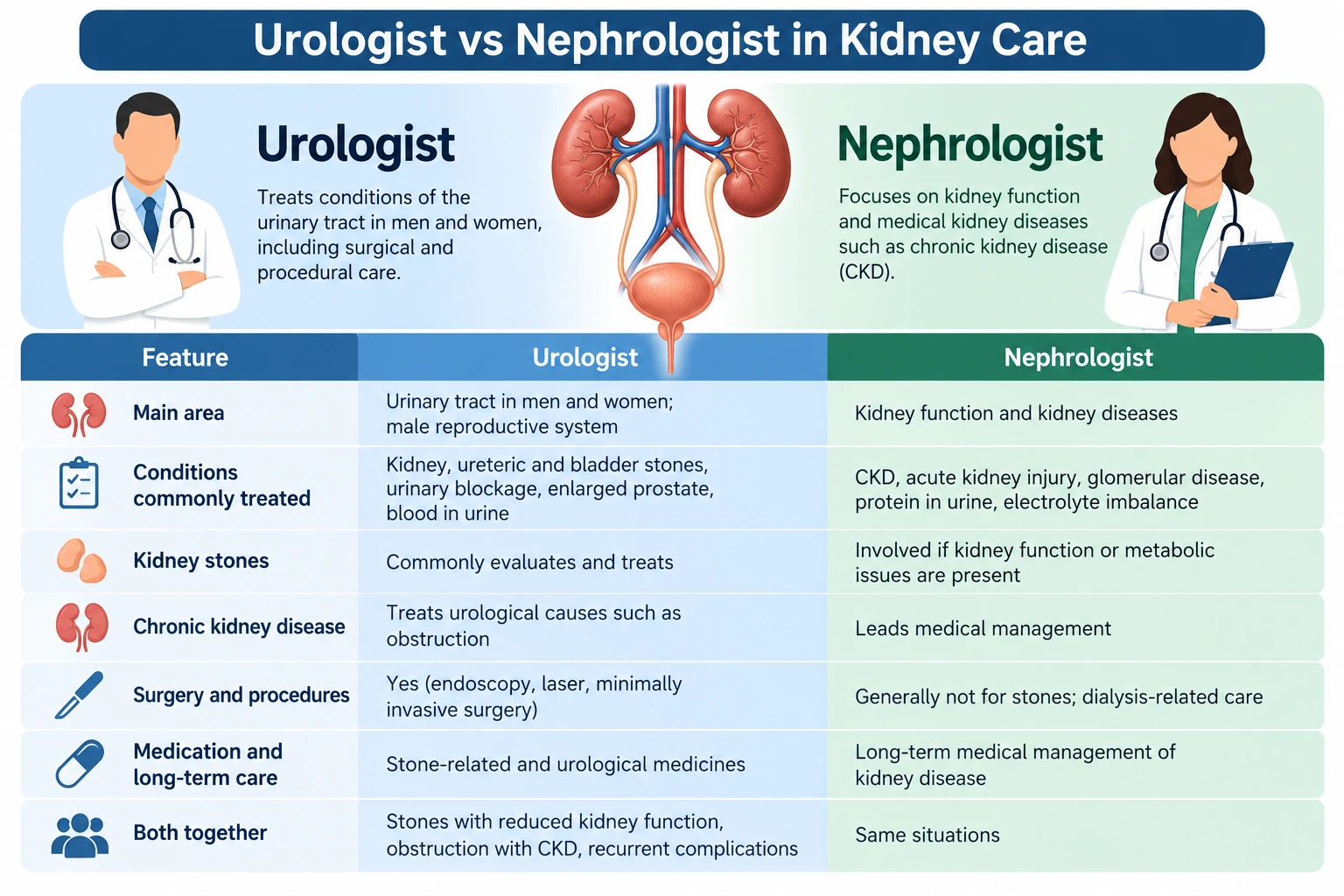
A urologist treats conditions of the urinary tract (kidneys, ureters, bladder, urethra), including surgical and procedural care. A nephrologist specialises in kidney function and medical kidney diseases such as chronic kidney disease (CKD).
Neither specialist is “better” than the other. They look at the kidney from different angles, and many patients are well served by one, while some need both.
| Feature | Urologist | Nephrologist |
|---|---|---|
| Main area | Urinary tract in men and women; male reproductive system | Kidney function and kidney diseases |
| Conditions commonly treated | Kidney, ureteric and bladder stones, urinary blockage, enlarged prostate, blood in urine | CKD, acute kidney injury, glomerular disease, protein in urine, electrolyte imbalance |
| Kidney stones | Commonly evaluates and treats | Involved if kidney function or metabolic issues are present |
| Chronic kidney disease | Treats urological causes such as obstruction | Leads medical management |
| Surgery and procedures | Yes (endoscopy, laser, minimally invasive surgery) | Generally not for stones; dialysis-related care |
| Medication and long-term care | Stone-related and urological medicines | Long-term medical management of kidney disease |
| Both together | Stones with reduced kidney function, obstruction with CKD, recurrent complications | Same situations |
What Does a Urologist Treat?
A urologist is a medical specialist who diagnoses and treats disorders of the urinary tract in men and women, as well as the male reproductive system. Common concerns include:
- Kidney stones, ureteric stones and bladder stones
- Blockage in the urinary tract and structural problems
- Blood in the urine that needs evaluation
- Recurrent urinary problems needing urological assessment
- Enlarged prostate and other male urinary conditions
Depending on the diagnosis, treatment may involve medication, endoscopic procedures, minimally invasive surgery or other interventions. So, yes, a urologist can be considered a kidney specialist for stones, obstruction and other structural or surgical kidney problems, though not for medical kidney disease such as CKD.
What Does a Nephrologist Treat?
A nephrologist focuses on how the kidneys work. Typical concerns include chronic kidney disease, acute kidney injury, glomerular diseases, protein in the urine, persistently abnormal kidney function tests, and kidney-related electrolyte or acid-base imbalances. Nephrologists also manage kidney complications of diabetes and high blood pressure, care for advanced kidney disease, and assess patients for dialysis or transplantation where needed. They generally manage kidneys medically, rather than treating urinary stones surgically.
Urologist vs Nephrologist: Key Differences
In practical terms:
- Diagnosis: Urologists often begin with the structure and drainage of the urinary tract; nephrologists with filtration, blood chemistry and urine protein.
- Medication: Nephrologists run long-term medical plans for kidney disease; urologists prescribe medicines for stones, infections or prostate conditions.
- Surgery: Procedures such as stone removal fall under urology.
- Kidney stones: Usually a urology concern first.
- Long-term kidney disease: Usually a nephrology concern.
So when comparing urologist vs nephrologist in Bangalore or anywhere else, the question is not which is superior, but which problem you have.
Which Doctor Should You See for Kidney Stones?
A urologist is commonly the first specialist for kidney stones, ureteric stones and urinary obstruction. If you are wondering which doctor for kidney stones in Bangalore to consult, a urologist is the usual starting point.
A urologist typically assesses stone size, location and number, reviews symptoms and imaging, and decides whether observation, medication or a procedure is appropriate. The decision depends on stone characteristics, symptoms, obstruction, infection risk, kidney function and your overall health. Follow-up and recurrence-prevention planning are also part of care.
When Can Kidney Stones Pass Naturally?
Small stones may pass on their own, especially when they are not causing blockage, infection or severe pain. Stone size and position in the ureter strongly influence this. Even then, monitoring matters, because a silent obstruction can affect the kidney. Your doctor may suggest pain control, medication to help passage, and repeat imaging.
When Is a Kidney Stone Procedure Necessary?
Procedures may be considered when a stone is unlikely to pass, causes persistent pain or blockage, or is linked to infection or reduced kidney function. Options include:
- Shock wave lithotripsy (SWL): shock waves break the stone from outside the body, where suitable.
- Ureteroscopy with laser: a thin scope reaches the stone, which is fragmented with laser.
- Retrograde intrarenal surgery (RIRS): flexible scope treatment for stones inside the kidney.
- PCNL and mini-PCNL: keyhole surgery through the back, generally for larger or complex stones.
The right choice depends entirely on individual findings, and not every stone needs surgery.
When Should You See a Nephrologist?
See a nephrologist when tests suggest your kidneys may not be functioning properly, rather than when the problem is a stone alone.
Evaluation may be appropriate for:
- Persistently abnormal creatinine or estimated glomerular filtration rate (eGFR)
- Persistent protein or albumin in the urine
- Suspected or confirmed CKD
- Significant electrolyte abnormalities
- Kidney complications of diabetes or hypertension
- Unexplained decline in kidney function
- Planning for advanced kidney disease or dialysis
Remember that one abnormal result does not automatically mean CKD; doctors interpret results in clinical context and often repeat tests.
Can You Need Both a Urologist and a Nephrologist?
Yes, in some cases, but not for everyone.
Examples include a person with kidney stones and reduced kidney function, an obstructing stone in someone with existing CKD, or recurrent stones alongside a medical kidney condition. The urologist may clear the obstruction while the nephrologist guides kidney protection and long-term medical care. Most people with a single uncomplicated stone only need a urologist.
What Tests Help Determine Which Specialist You Need?
Tests depend on symptoms and history. Commonly used ones include:
- Urine analysis and urine albumin or protein testing
- Serum creatinine and eGFR
- Blood electrolytes, when indicated
- Ultrasound and, where appropriate, other imaging
- Further tests chosen by your doctor
When Should You Seek Urgent Medical Attention?
Seek emergency care without delay for:
- Fever or chills with suspected kidney stones or urinary obstruction
- Severe or persistent flank pain
- Inability to pass urine
- Repeated vomiting or being unable to keep fluids down
- Blood in urine with significant symptoms
- Markedly reduced urine output
An infected, blocked kidney is a medical emergency. Do not postpone care while deciding which specialist to book; go to the nearest emergency department.
How Can You Protect Your Kidney Health?
Prevention depends on the underlying condition, so personalised advice matters. In general:
- Maintain adequate hydration, unless a doctor has restricted your fluids
- Follow individualised dietary advice for stone prevention, with sensible salt intake and balanced nutrition
- Control diabetes and blood pressure
- Avoid using painkillers or other medicines without medical advice
- Attend follow-up kidney function tests when advised
- Discuss stone analysis and metabolic evaluation if stones recur
Fluid targets and diets are not the same for everyone, so confirm yours with your doctor.
Finding a Kidney Specialist in Bangalore
When searching for a kidney specialist Bangalore residents can trust, start with your symptoms and diagnosis. If you have stone pain, urinary blockage or blood in urine, a urologist is usually appropriate. If your reports show raised creatinine, low eGFR or persistent protein in urine, a nephrologist is usually appropriate. Your family physician can help you decide, and you can ask the clinic what conditions it treats before booking.
Kidney Doctor vs Urologist in Bangalore: How Do You Decide?
The phrase “kidney doctor” can mean either specialist. In the kidney doctor vs urologist in Bangalore question, clarify what you need: evaluation of kidney function, a urinary tract disease, or stones. Function problems point towards nephrology; stones and structural issues point towards urology. If unsure, a general physician or either specialist can guide referral.
Consulting a Urologist in Bangalore
Dr. Uday Bhaskar is a Urologist & Andrologist. His speciality is urology and andrology, not nephrology. A urology consultation is relevant for kidney stones, urinary tract conditions and related concerns. If you would like to consult a urologist in Bangalore, you can use the contact or appointment page on the clinic’s website to enquire about availability.
Conclusion
Urologists treat urinary tract conditions and perform relevant procedures, while nephrologists focus on medical kidney diseases and kidney function. The right choice of urologist vs nephrologist in Bangalore depends on your condition, and the two often collaborate when needed. If you have symptoms or abnormal reports, seek a proper medical assessment, and go to emergency care for warning signs.
Medical Disclaimer
This article is for general educational purposes only and does not replace professional medical evaluation, diagnosis or treatment. Individual needs vary. Please consult a qualified doctor about your condition. Seek urgent medical care for serious warning signs such as fever with flank pain, inability to pass urine, persistent vomiting or severely reduced urine output.